






 DARK
 1
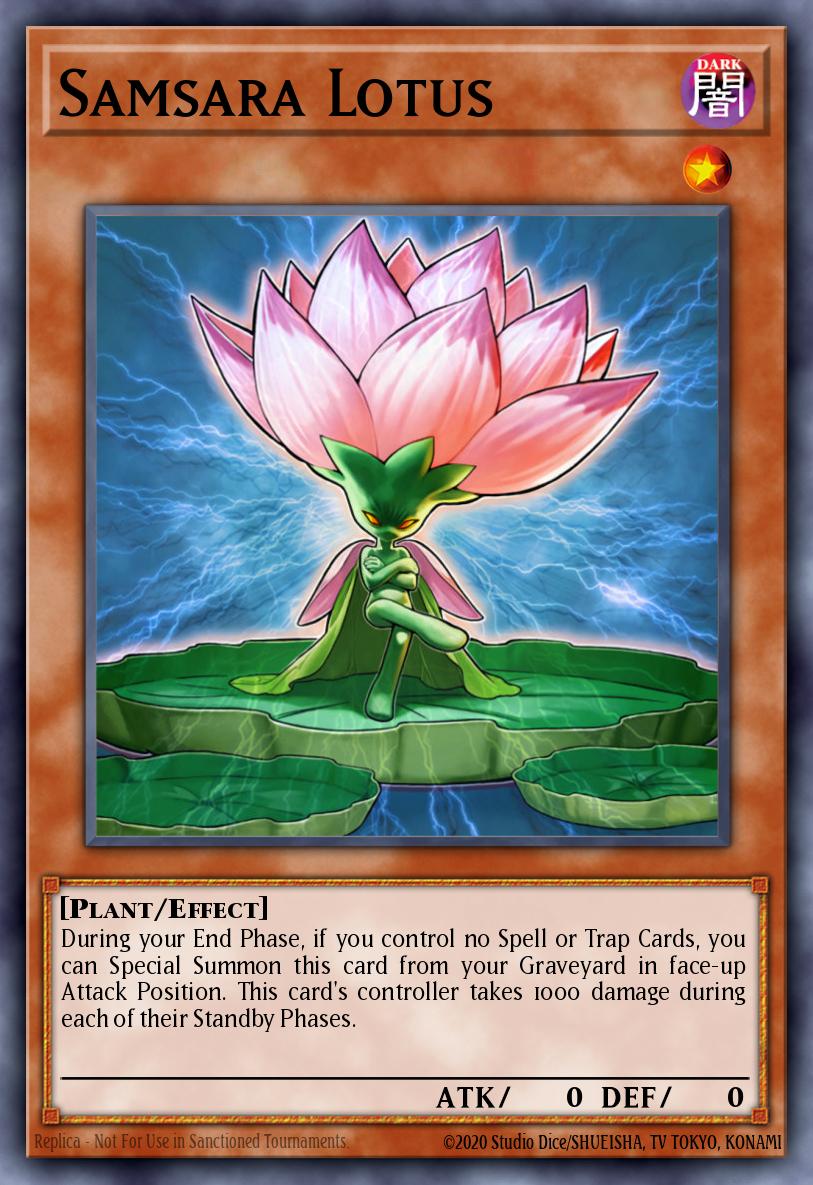
Samsara Lotus
ATK:
0
DEF:
0
View:
4752
During your End Phase, if you control no Spell or Trap Cards, you can Special Summon this card from your Graveyard in face-up Attack Position. This card's controller takes 1000 damage during each of their Standby Phases.

Samsara Lotus — Power Evaluation
Final Score: 63 ± 4 · Confidence: Medium
- Intrinsic: 64 · Deck: 63 · Meta: provisional
- Primary role: Material body · Secondary: Recovery/Recursion
Why it scores here
Samsara Lotus scores as a generic Level 1 body prized for its material utility across 27 distinct archetypes, where its clean stats and type make it a splashable synchro/XYZ filler. The GY recursion condition (no S/T on board) gates its secondary recovery angle to specific homes like Yubel and Unchained, but the consistent 2.75-copy inclusion across TCG and OCG formats confirms its primary role as a portable material staple. The self-damage (1000 LP per Standby Phase) and lack of disruption or card advantage prevent a higher score; the card does not build combos on its own or drive synergy engines, only refuel an existing strategy as an expendable body.
Axis scores
| Axis | Score | Evidence |
|---|---|---|
| Accessibility | 65 | The card is consistently run at 2.75 copies across 400 matched decks and 27 archetypes, with 100% inclusion in the main deck, confirming high accessibility as a staple material despite the GY recursion condition restricting comeback timing to low-S/T boards (observed). |
| Combo & Conversion | 40 | As a Level 1 body with 0 ATK/DEF and no self-synergy, the card builds no board alone; combo boards are inferred to use it as a synchro material or filler, but zero recorded combo appearances prevent direct measurement of conversion scaling (inferred). |
| Resource Economy | 45 | The GY recursion (if no S/T) is a one-card refuel per turn cycle, roughly neutral on card advantage, but the 1000 LP self-damage per Standby Phase is a real deck-building cost that offsets the recursion value (verified). |
| Effect & Interaction | 5 | The card provides zero disruption, negation, removal, or hand-trap effects; the self-damage is a deck-building liability, not opponent interaction (verified). |
| Material Utility | 75 | As a Level 1 DARK Plant with a clean body and no effect locks, the card is excellent generic material for synchros (Tuner + 1-Level = L2+), usable even when its effect is negated, and is the primary driver of 27-archetype portability (verified). |
| Resilience & Flexibility | 55 | Multiple copies (2.75 average) and spread across 27 distinct archetypes provide redundancy; once in the GY, the recursion is reliable if the S/T condition is met, but the self-damage and effect-reliance limit flexibility in higher-interaction formats (observed). |
| Deck-Building Efficiency | 70 | Running 3 copies is clean for a Level 1 body (no brick risk); the S/T recursion condition is a soft gate beneficial for low-S/T strategies like Yubel and Unchained, but the self-damage accrual requires LP management across the match (verified). |
Calculation
Weight profile: Primary role: Material body. Intrinsic ≈ 64, Deck ≈ 63, Meta = provisional. Modifiers: none. Final formula: 0.40*Intrinsic + 0.60*Deck (decks present, meta unknown)
Strengths
- Clean Level 1 body with zero stat awkwardness, enabling flexible synchro/XYZ lines.
- Portability across 27 distinct archetypes confirms generic material value independent of archetype synergy.
- Consistent 2.75-copy inclusion in 400 matched decks signals reliable access and low brick risk.
- Recursion from GY (no S/T condition) enables repeated refuel in low-S/T strategies like Yubel and Unchained.
Weaknesses
- Self-damage (1000 LP per Standby Phase) is a real resource cost that accumulates over a match.
- Zero effect interaction: no disruption, negation, removal, or card advantage on its own.
- GY recursion condition (no S/T on board) severely restricts comeback timing in S/T-heavy decks.
- Combo data absent, so recursion value in practice is inferred, not measured.
Counters / choke points
- Any S/T lock (Skill Drain, Forbidding Droplet at the right moment) shuts down GY recursion.
- Banishing effects (dimensional barriers) remove the card from GY, cutting off refuel.
- Damage-focused strategies exploit self-damage accumulation as a clock.
Best use
Generic Level 1 synchro filler with GY refuel in low-S/T strategies. Decks: Yubel, Unchained, Fiendsmith, Phantasm Spiral, D/D/D. Suggested copies: 3.
Evidence & gaps
- Verified: Card text: GY recursion at End Phase if no S/T on board; Standby Phase self-damage 1000 LP.; Format legality: TCG, OCG, MasterDuel, DuelLinks.; Deck inclusion: 100% of 400 matched decks run it (2–3 copies, average 2.75).; Archetype spread: 27 distinct archetypes, no single-archetype dependency.; Level 1 body: clean generic material for synchros, no stat penalties or effect locks.
- Observed: Yubel dominance in matched decks (163/400 = 40.8%) suggests archetype-specific strength.; Top partners all Yubel-specific (Spirit of Yubel 100%, Yubel 99.2%), confirming Yubel as primary home.; Unchained secondary home (22.8%) also runs low S/T, validating recursion condition relevance.; Consistent 2.75 copies across all decks confirms staple status independent of archetype.
- Inferred: GY recursion is valuable for low-S/T decks (Yubel, Unchained) due to condition gate.; Level 1 body enables Tuner + 1-Level synchro plays (standard synchro math).; As a filler material, the card refuels synchro/XYZ lines without building unique combos.; Self-damage accumulates as a deck-building cost, requiring LP buffer or healing.
- Data gaps: No combos supplied — combo conversion is text-only inference, not measured. No guides supplied — no human context on intended role or synergy cues. No combo examples for the recovery angle — cannot verify GY recursion impact in practice. No top-card ranking — cannot confirm meta prominence (though consistent deck inclusion suggests strong accessibility).